Topological Regime
Planetary Scale and Body Narrative
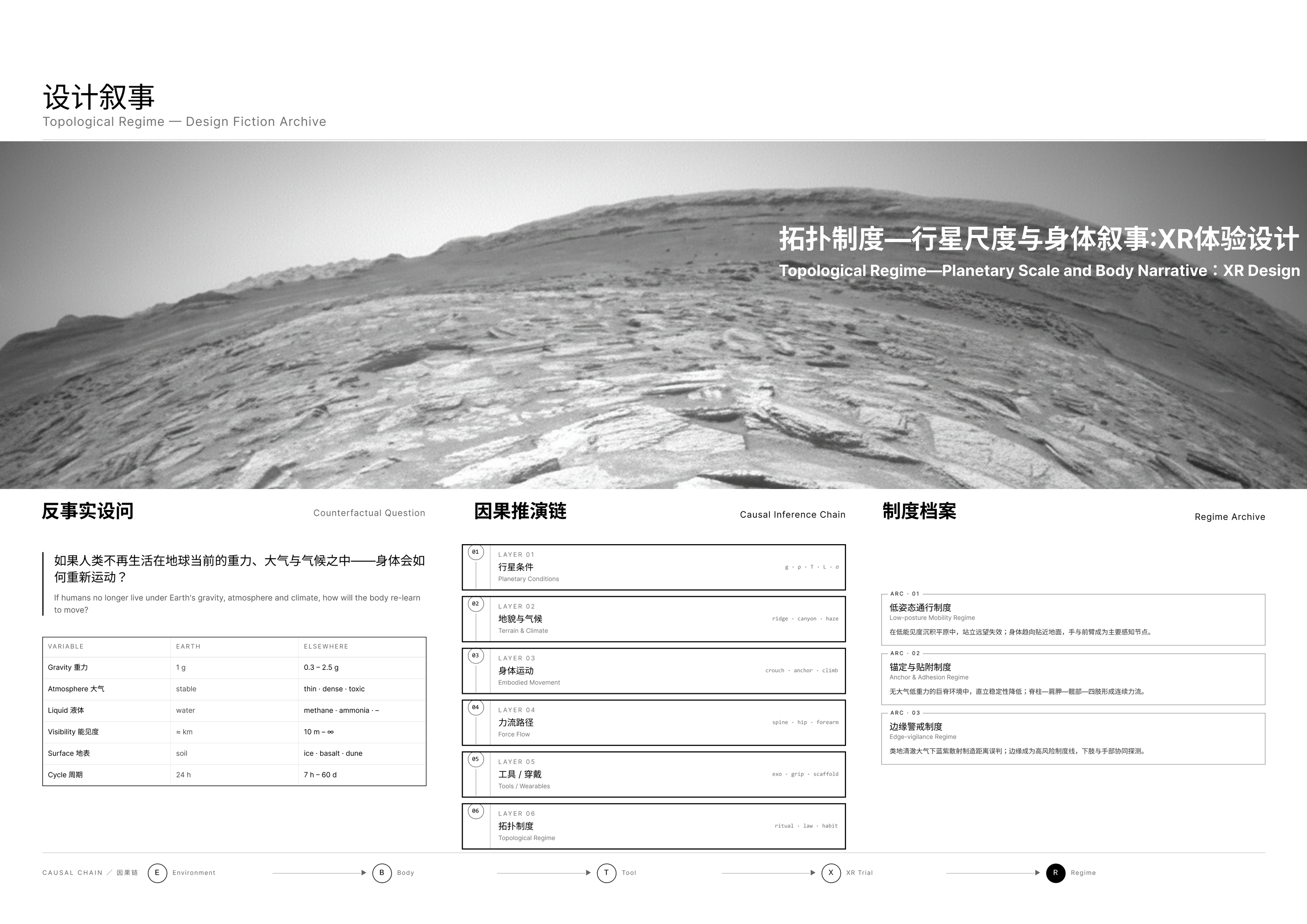
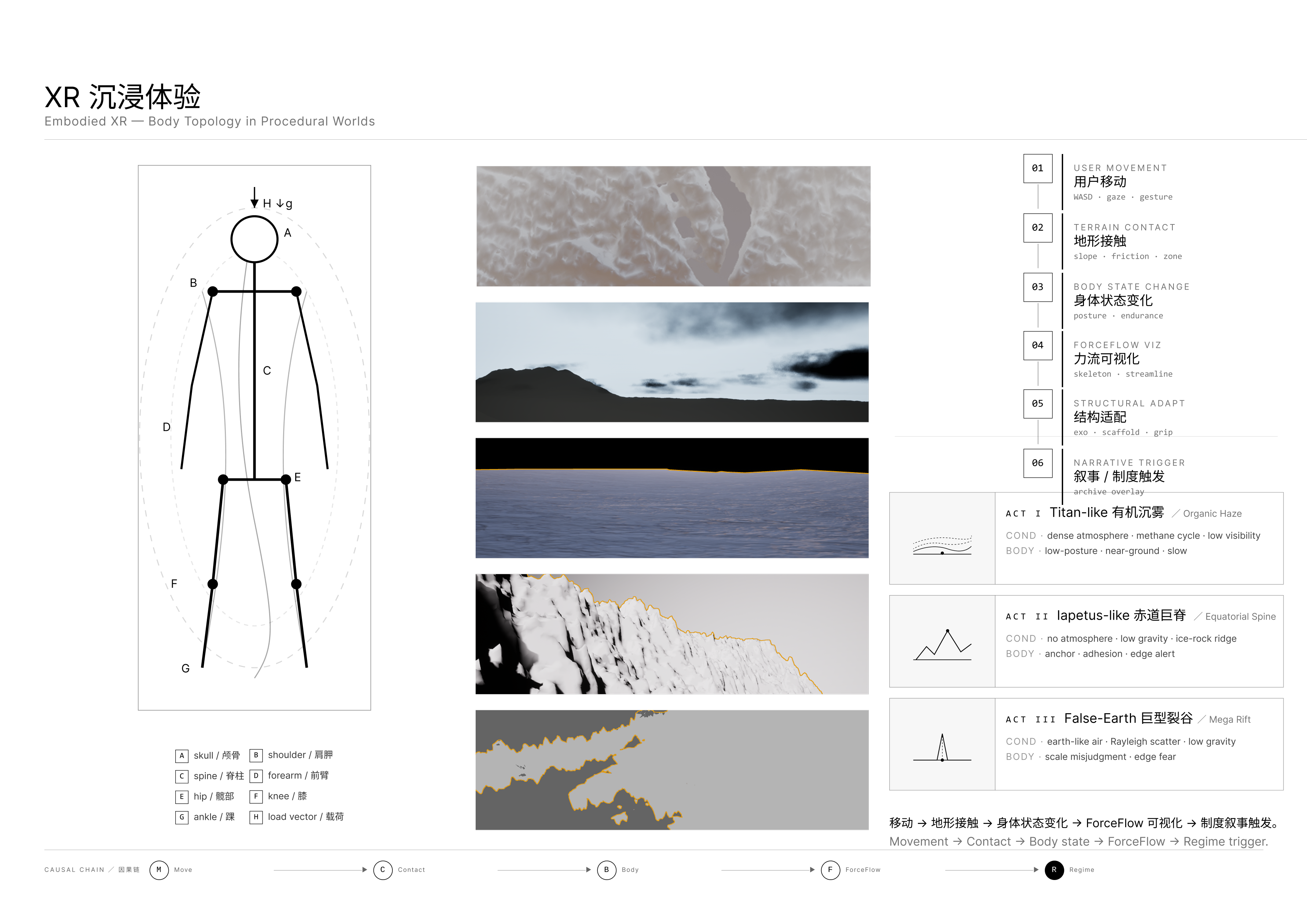
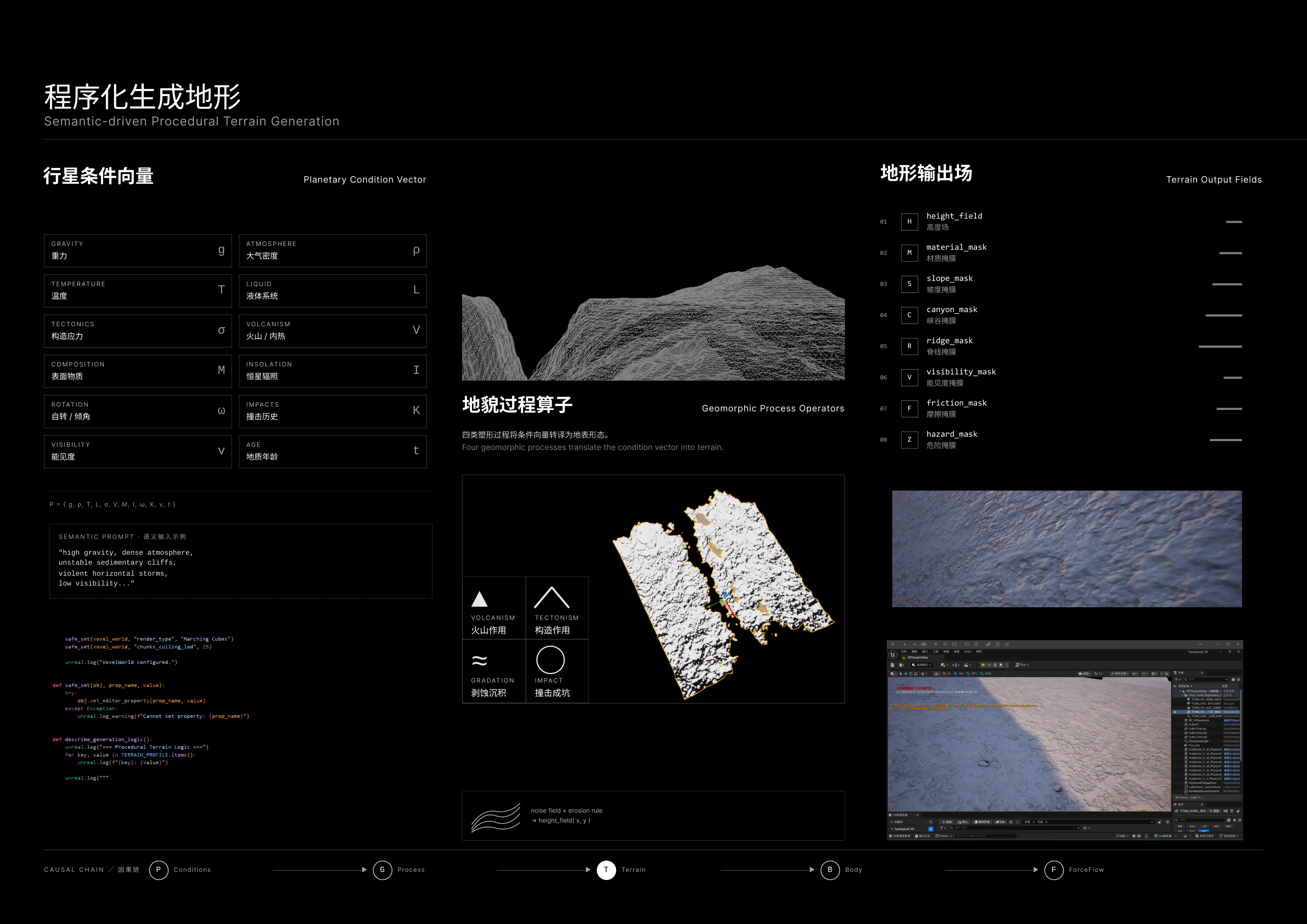
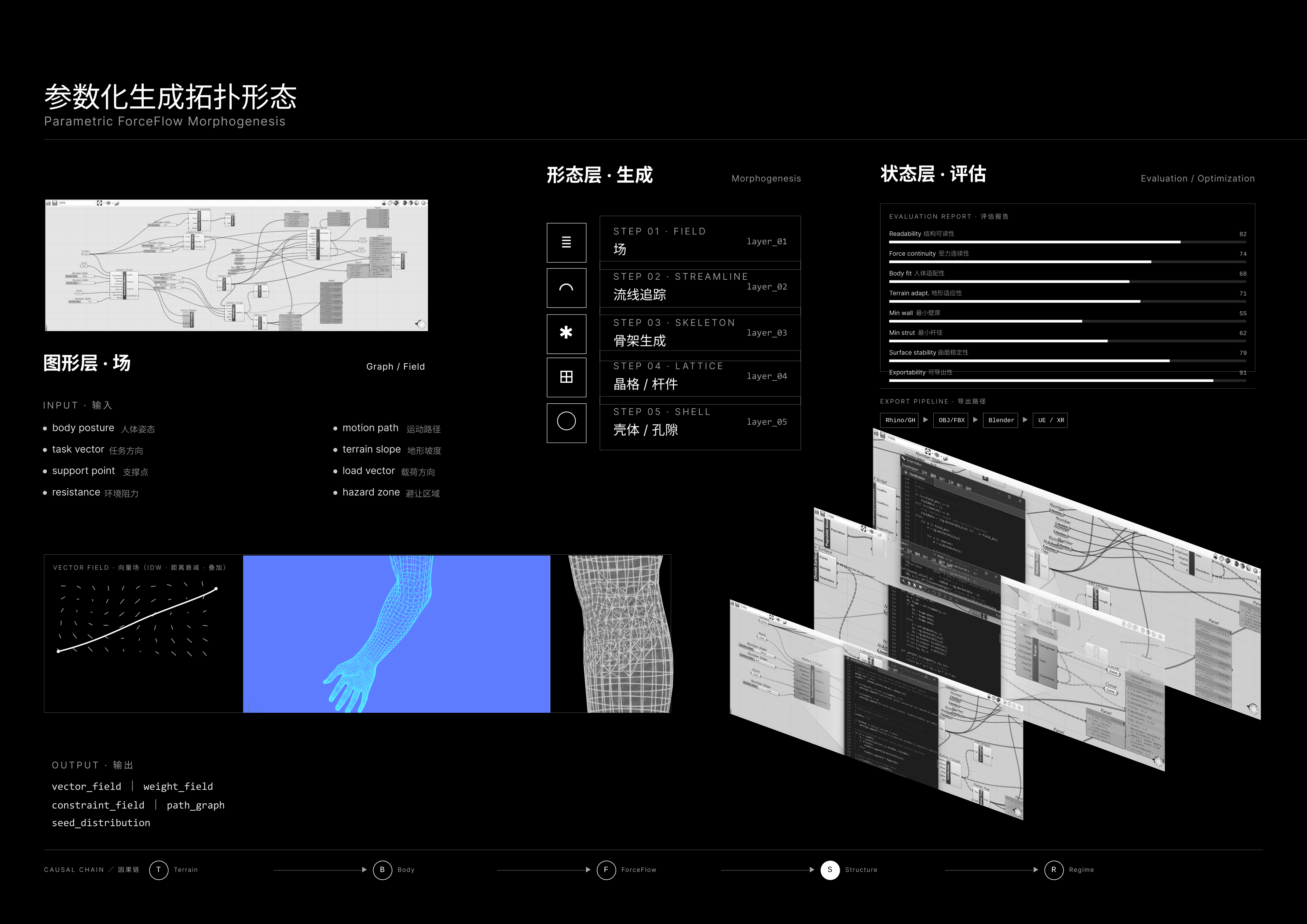
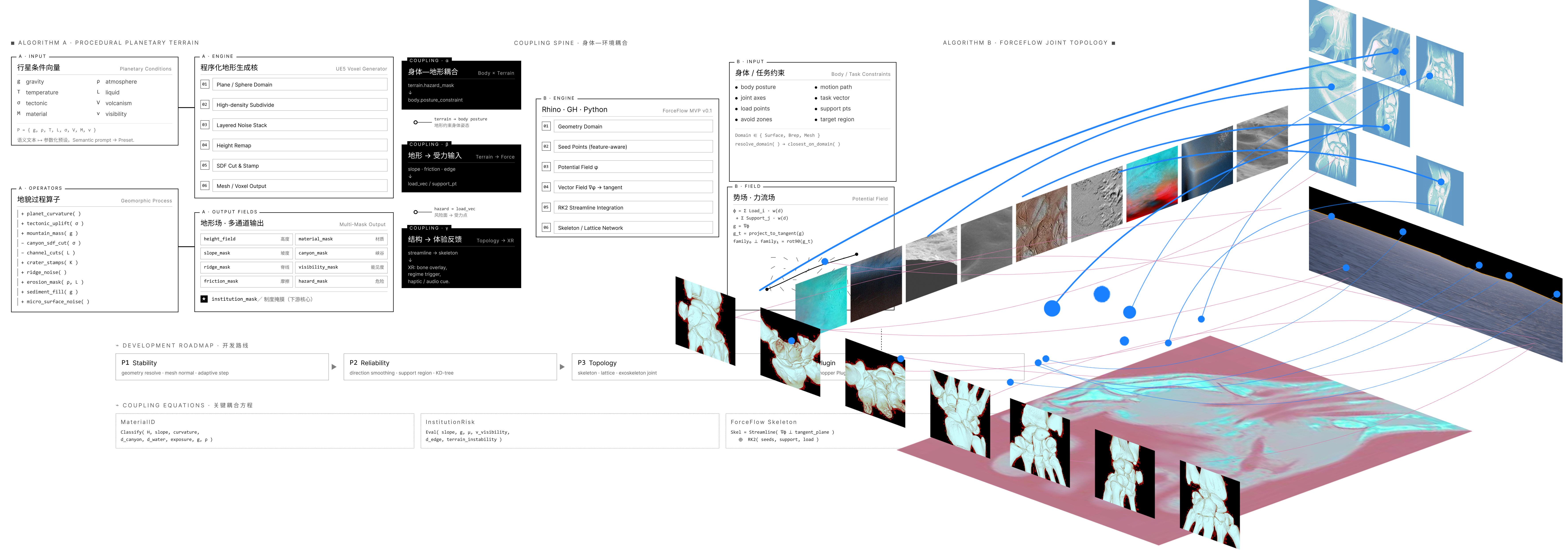
If the physical rules of the world changed, would human bodies, tools, and societies still exist in their current form? Topological Regime is an experimental design research project combining parametric morphology generation, human dynamics, design fiction, and XR immersive experience. It begins from a counterfactual question: if humans did not live under Earth's current gravity, atmosphere, terrain, and climate, how would bodily movement, skeletal structure, and bodily systems be reshaped? The term “topology” carries different meanings across space, body, perception, and engineering optimization. First, topology points to a relational view of space: it is concerned not with fixed outward form or scale, but with how paths connect, how boundaries appear, how inside and outside fold into each other, and what forms of accessibility and constraint a body encounters in space. It is also a way of understanding body and perception: the body is in fact a variable structure that continuously reorganizes its movement grammar, sensory hierarchy, and existential boundaries under different environmental pressures. In an engineering sense, topology also refers to a structural optimization logic based on force transmission, material distribution, and performance constraints, allowing form to become a result derived jointly from environment, action demands, and structural efficiency. The project treats planetary conditions as generative premises for bodily and structural form. Gravity, atmospheric density, surface friction, rock formation, storm frequency, lighting conditions, and terrain scale on different planets would alter how individuals move, climb, carry weight, avoid danger, collaborate, and build. Over time, these environmental pressures would not only affect posture and movement mechanisms, but also transform wearable devices, assistive structures, architectural systems, and social organization. The project therefore proposes the idea of a topological regime: beyond law, rules, or social order, a regime can also be understood as a topological structure jointly produced by body, environment, technology, and space. The project attempts to use mature topology optimization techniques from engineering workflows as its core generative logic. In this design, morphology generation is redefined as a coupling flow that connects body, task, environment, and structure. The basic methodology is graph → form → state: first, bodily posture, movement paths, force directions, terrain conditions, task demands, and environmental constraints are translated into visual fields, vectors, or graph structures; then, through streamline tracing, skeleton generation, lattice filling, and topological growth, structural candidates are generated; finally, manufacturing constraints and environmental adaptability are evaluated and fed back to form a closed-loop design process. The project is progressing toward the Grasshopper / GH Python prototyping stage, involving field construction, IDW interpolation, surface streamline tracing, seed point control, skeleton generation, basic evaluation reports, and manufacturing constraint checks. Later development will continue toward three-dimensional force-flow lattice generation and complex surface stability optimization. At the visual and experiential level, Topological Regime builds immersive planetary environments in Unreal Engine, exploring procedural terrain generation, large-scale natural landforms, special weather systems, first-person / third-person body skeleton visualization, and XR experience. The project aims to let viewers perceive a clear causal chain: how planetary conditions reshape terrain, how terrain changes bodily movement, how bodily movement generates new structural forms, and how those forms eventually shape a new mode of survival.